Chasing safer welds in high temperatures
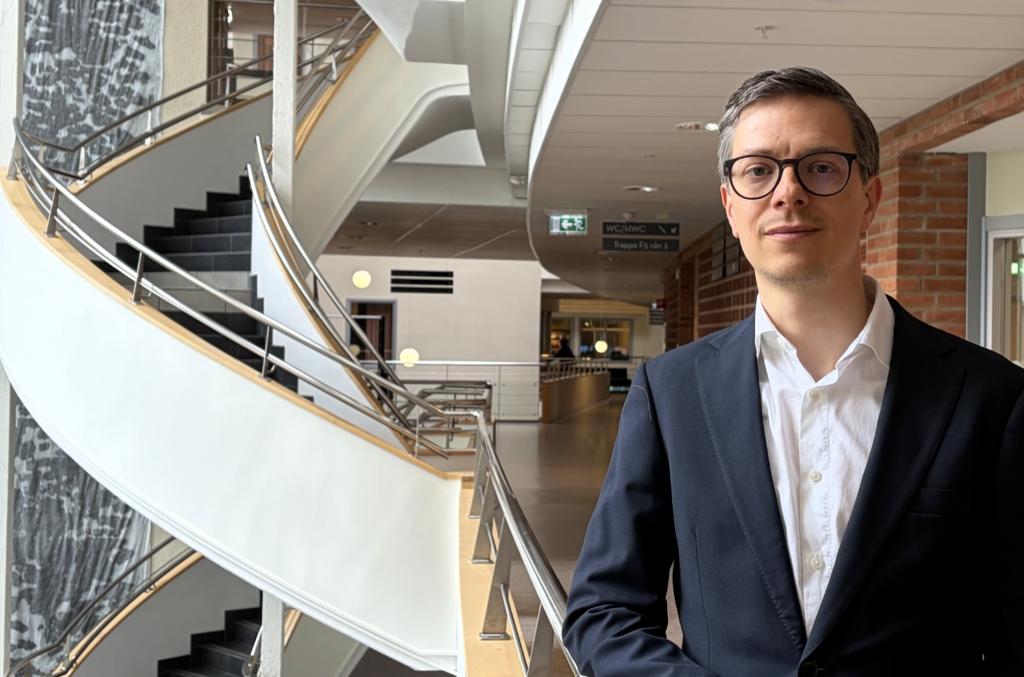
Welding of materials that must withstand high temperatures and high pressure is one of the most complex procedures in industry, where even tiny cracks can have serious consequences. These cracks – known as hot cracks – are exactly what the industrial doctoral student Mikael Johansson has devoted much of his research to, focusing on both how they form and how they can be minimized.
“When you weld, you are essentially performing a miniature casting. You melt the material and allow it to solidify again, but without anything like the same level of control as when the material is originally manufactured. That’s what makes welding so complex – and so fascinating to research,” says Mikael.
Small cracks with major consequences
Mikael is an industrial doctoral student at University West and simultaneously works as a researcher and welding engineer at Alleima EMEA, a world-leading materials technology company that develops and manufactures highly refined products in advanced stainless steels and special alloys.
In his licentiate thesis, Hot Cracking Susceptibility in Austenitic High-Temperature Alloys, he studied so-called hot cracks, which can form when metallic materials are welded and solidified. The thicker the material, the greater the stresses and the higher the risk of cracking. The issue is particularly critical in environments such as thermal power plants, where materials are exposed to high temperatures of up to 700°C combined with very high pressure.
Testing materials by intentionally provoking cracks
To understand how susceptible different materials are, Mikael used a method in which cracks are deliberately created. The cracks are then carefully examined under a microscope.
“We melt the surface of a specimen while simultaneously bending it. This simulates what happens in a real weld. By varying the degree of bending, we can see at what stress levels cracks occur and how many that forms. We then measure the length and number of cracks and compare different materials.”
The weld is not the weakest link
Mikael has studied both various types of stainless steel commonly used in components such as pipes for high-temperature environments, and nickel-based alloys or filler metal used in the welding process itself. Among other things, he examined the stainless steel Sanicro® 25, developed to withstand high temperatures, and the widely used filler metal Alloy 617. The results show that even small changes in the composition of the filler metal can have a major impact.
“We see that a modified variant, which we call Alloy 617mod., generally performs better. It shows lower susceptibility to cracking and improved properties. It’s also the version we already recommend to customers, so it’s reassuring that the research confirms this.”
One of the central conclusions of Mikael’s research is that the filler metal and the weldment itself are not the weakest link.
“If we weld a Sanicro® 25 pipe using the right filler metal, the weld will not be the limiting factor. Instead, it’s the base material of the pipe that sets the limit – which is exactly how you want it. Ideally, the weld should outperform the base material, not the other way around.”
The human factor affects the results
Another part of the research has focused on how cracks are measured. Mikael compared traditional methods, such as manual examination under a microscope, with digital image analysis. The results showed that when several people manually evaluated the same specimen, they produced different results.
“Interpretations vary slightly. That shows the method is highly dependent on the individual. I believe the solution lies in digitalization. When you work with digital images and analyze them afterwards, you get much better traceability. You can see exactly how an assessment was made. In the long term, this could be automated even further – perhaps using AI-based image analysis.”
Driven by complexity
Mikael’s interest in welding is no coincidence. He describes it as a classic engineering motivation: problem-solving. You start with a problem you don’t fully understand and keep digging until you do.
“I realized quite early on that this field is incredibly complex. Corrosion, mechanical properties, defects – everything is interconnected. There are so many questions to answer. That’s what drives me.”
Research with immediate industrial impact
The results of Mikael’s research are already being used in industry and at his workplace, Alleima EMEA – both for material selection, method development, and the creation of new alloys, as well as for improving how cracks are evaluated.
At its core, Mikael’s research is about reducing risks in advanced technical systems. These systems often operate under high pressure and extreme temperatures, and failure can have serious consequences. Even small cracks can therefore have major implications.
“It’s often the smallest details that make the difference. By understanding them better, we can build better, safer, and more sustainable solutions in the future,” says Mikael.
Mikael Johansson is one of several industrial doctoral students participating in the Smart Industry Sweden research school, where University West is one of five participating universities.
Read more about Mikael’s research
The licentiate thesis can be accessed here: “Hot Cracking Susceptibility in Austenitic High-Temperature Alloys”
Contact:
Mikael Johansson, Welding Engineer, Alleima EMEA
At University West, we conduct research in collaboration with society and industry to help create a better future.